
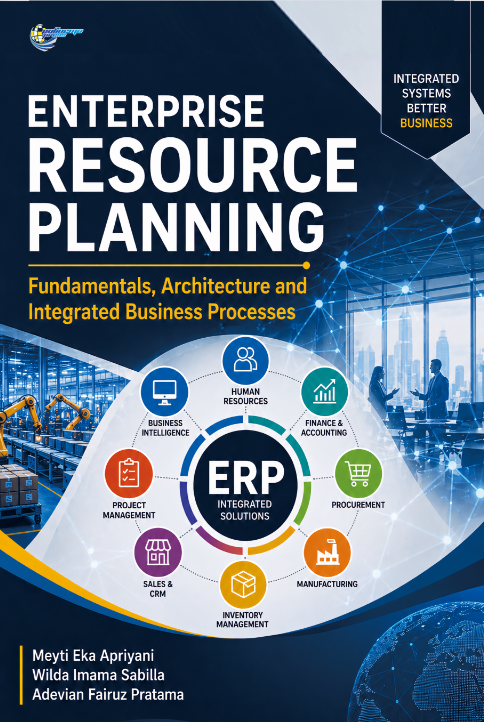
Enterprise Resource Planning: Fundamentals, Architecture, and Integrated Business Processes
Modern organizations operate in an environment where information must move quickly, decisions must be based on reliable data, and business functions can no longer work in isolation. Enterprise Resource Planning (ERP) has emerged as a fundamental approach to integrating organizational processes, enabling departments to share information, coordinate activities, and improve overall efficiency. Understanding ERP is therefore no longer limited to technology professionals. It has become essential for anyone seeking to understand how contemporary organizations manage resources, streamline operations, and create sustainable value.
Enterprise Resource Planning: Fundamentals, Architecture, and Integrated Business Processes provides a comprehensive exploration of ERP, beginning with its fundamental concepts and historical evolution before examining the architectures, components, and technologies that support modern enterprise systems. The book explains how ERP serves as the backbone of integrated business operations by connecting data, processes, and decision making across an organization.
Readers are guided through the principles of integrated business processes and the relationships among key functional areas, including procurement, sales and distribution, inventory management, supply chain management, finance, accounting, production planning, manufacturing, human resource management, customer relationship management, and point of sale systems. Each topic is presented within the broader context of organizational integration, allowing readers to understand not only the purpose of individual modules but also how they interact to support efficient and coordinated business operations.
Beyond conceptual foundations, the book explores practical aspects of ERP implementation, including implementation methodologies, organizational readiness, system migration, data conversion, project management, performance evaluation, and the risks that commonly influence implementation outcomes. An introduction to ERP implementation using Odoo further illustrates how theoretical concepts are translated into integrated enterprise solutions within real organizational environments.
Designed with a logical and progressive structure, this book combines conceptual clarity with practical relevance. Chapter summaries and assignments encourage readers to reinforce their understanding while developing analytical perspectives on enterprise integration and digital business transformation.
Whether the reader is beginning to explore ERP or seeking a structured reference on integrated enterprise systems, this book offers a balanced and comprehensive understanding of the principles that shape modern organizational management. By emphasizing enduring concepts rather than software-specific procedures, it provides knowledge that remains relevant as technologies continue to evolve, making it a valuable resource for understanding the role of ERP in creating agile, data-driven, and interconnected organizations.
| Judul | Enterprise Resource Planning: Fundamentals, Architecture, and Integrated Business Processes |
| Penulis | Meyti Eka Apriyani, Wilda Imama Sabilla, Adevian Fairuz Pratama |
| ISBN | 978-634-327-020-1 |
| Jumlah Halaman | xiv; 122 pages. |
| Penerbit | Polinema Press |
| Tahun Terbit | 2026 |
| Stok | Ada |
| Pesan |


