Fundamentals of Technical Drawing for Vocational Civil Engineering Education
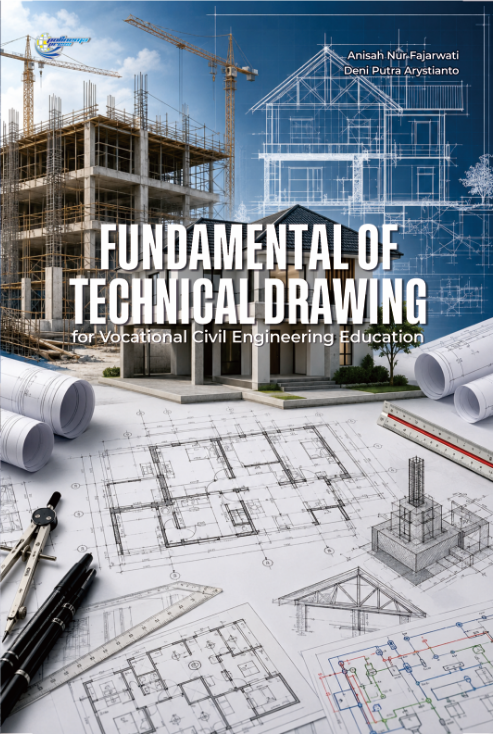
Fundamentals of Technical Drawing for Vocational Civil Engineering Education invites readers into the fascinating world where ideas take shape long before they become structures in the real world. More than a collection of drawing techniques, this book reveals how technical drawings serve as a universal language that connects creativity, precision, and practical construction.
Beginning with the fundamental principles of technical drawing, readers are introduced to the essential standards that ensure clarity and consistency in visual communication. From lettering conventions, line techniques, symbols, and hatching patterns to the proper use of drawing instruments and materials, every element is presented as part of a larger system that transforms concepts into meaningful graphical representations.
As the discussion develops, the book explores the art and science of projection methods, allowing readers to understand how three-dimensional objects can be accurately represented on a two-dimensional surface. Through pictorial, orthographic, European, and American projection systems, readers gain insight into the visual logic that lies behind every professional drawing.
The journey continues into the realm of working drawings, where technical accuracy meets real-world application. Dimensioning systems, scales, grids, and drawing layouts are presented as powerful tools for translating design intentions into information that can be understood and implemented with confidence. Each topic contributes to a deeper appreciation of how drawings guide the planning and execution of construction projects.
One of the book’s greatest strengths is its comprehensive exploration of building documentation. Readers are guided through architectural drawings, including floor plans, sections, elevations, site plans, and detailed design drawings. These chapters reveal how buildings are visualized, communicated, and refined through carefully structured graphic representations. Every drawing becomes a story of spatial organization, functionality, and design intent.
Beyond architectural representation, the book also examines the structural components that form the backbone of a building. Foundations, columns, beams, slabs, roof systems, and construction details are discussed through the lens of technical drawing, helping readers understand how structural concepts are communicated with precision and clarity. The integration of mechanical, electrical, and plumbing drawings further demonstrates the interdisciplinary nature of modern construction and the importance of coordination among various building systems.
Written in a clear and engaging style, this book encourages readers to see technical drawing not merely as a technical requirement, but as a powerful medium for thinking, designing, and communicating. It bridges fundamental knowledge with practical understanding, making complex concepts accessible while maintaining the depth expected from a comprehensive reference.
Whether viewed as an introduction to the language of construction, a valuable academic resource, or an exploration of the visual foundations behind the built environment, Fundamentals of Technical Drawing for Vocational Civil Engineering Education offers an enriching perspective on how lines, symbols, dimensions, and details come together to shape the spaces in which people live, work, and create.
| Judul | Fundamentals of Technical Drawing for Vocational Civil Engineering Education |
| Penulis | Anisah Nur Fajarwati, Deni Putra Arystianto |
| ISBN | 978-634-327-000-3 |
| Jumlah Halaman | xxii; 230 pages. |
| Tahun Terbit | 2026 |
| Penerbit | Polinema Press |
| Stok | Ada |
| Pesan |